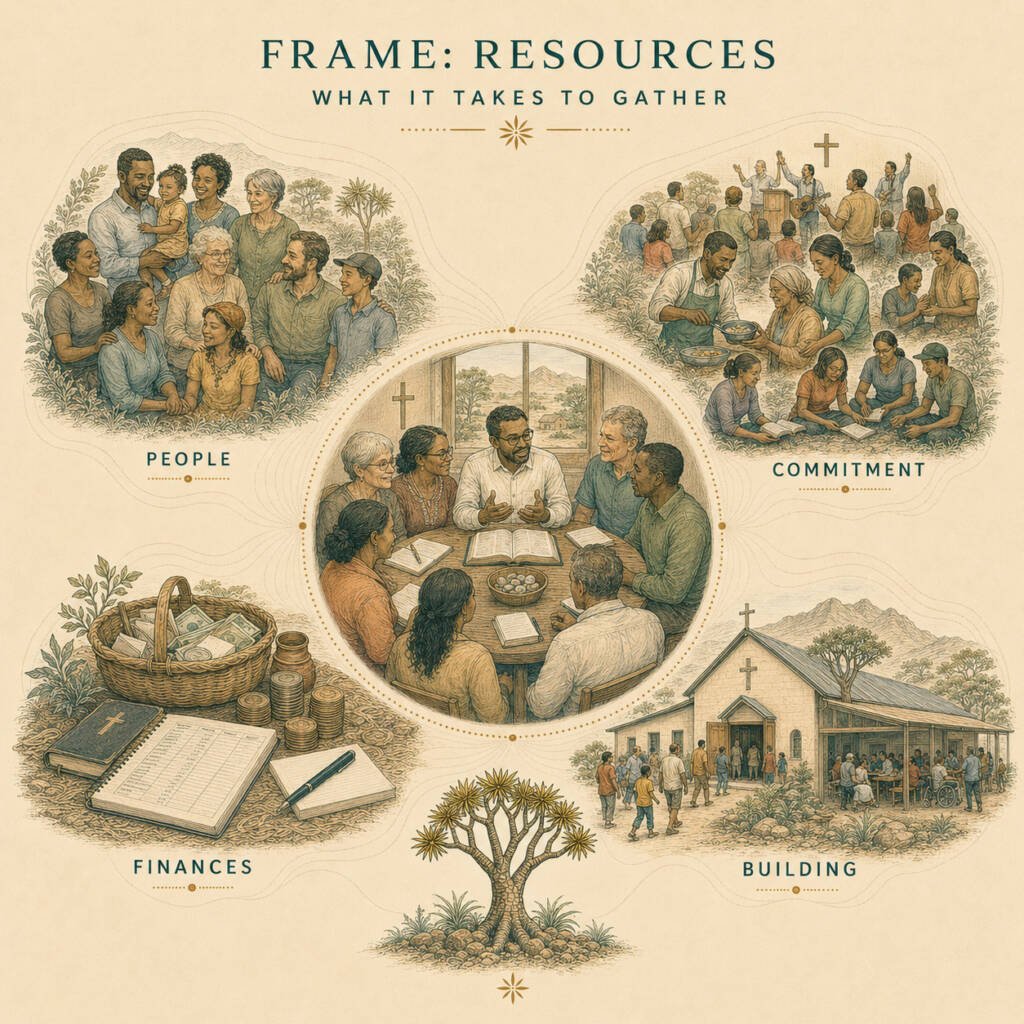
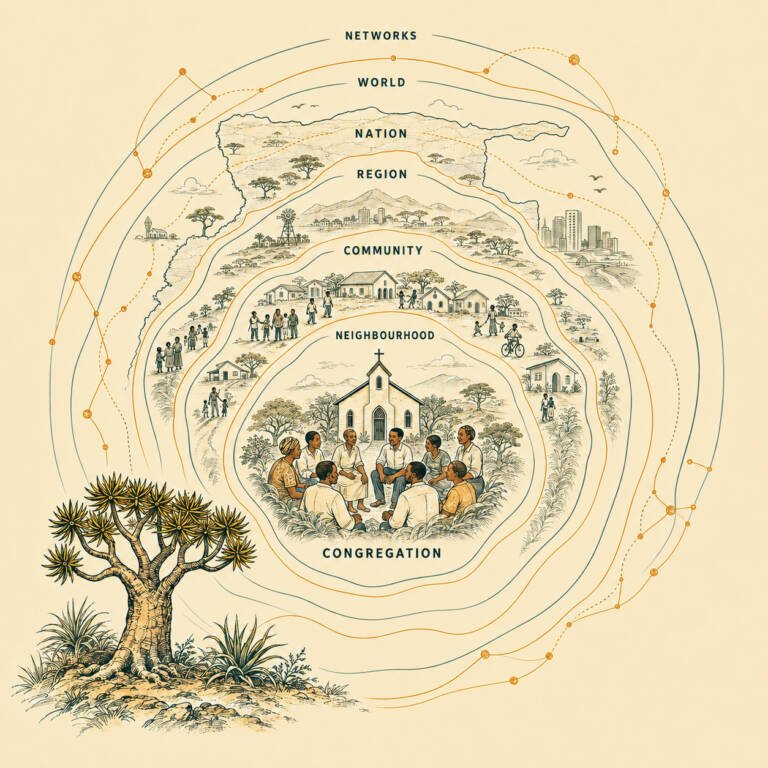
Kokerboom resources frame illustration showing people, commitment, finances and buildings supporting congregational renewal in Namibia.
CONGREGATIONAL RESOURCES

Understanding what a congregation has to carry out its calling

The resources frame helps congregations understand what is available to them as they carry out worship, care, leadership and mission. It looks beyond money to include people, commitment, finances and buildings as gifts that can be recognised, stewarded and used faithfully.

The resources frame is all about understanding what’s available to a congregation in its efforts to carry out its religious and social functions. Turns out it takes a lot!


RESOURCE FRAME

The people, commitment, finances and spaces that support mission

(A) People.

The most important resource of any congregation is its people. No people, no congregation! Yet, many congregations struggle to mobilize participants. People volunteering, their gifts/talents, relationships and shared experiences, members and non-members are all resources for the congregation.

(B) Commitment.

When they are mobilized, people are committed. Commitment though comes in many forms: worship attendance, volunteering, giving of financial resources, participating in small groups, community outreach, political organizing, etc. All these are ways people in congregations express their commitment.

(C) Financial.

The most obvious resources are likely financial ones. Participants in religious congregations donate a staggering about of money each year. And it’s a good thing because its takes a significant amount of money to keep a congregation going. Financial resources include offerings, endowments, legacy gifts, and other investments. Research shows that most congregations have a very hard time talking openly about money. This makes the task of resourcing a congregation quite challenging.

(D) Building.

If finances are the most obvious resource of a congregation, often the most under utilized one is a congregation’s building or physical space. Many congregations use their buildings only a few times a week. This has led many congregations to explore new ways of gathering in non-traditional spaces (e.g. coffee shops and pubs), online gatherings and shared spaces within the community.

FRAMES FOR STUDY

The Frame In Action

Kokerboom draws on the congregational study frameworks presented in Studying Congregations: A New Handbook, co-edited by Professor Nancy T. Ammerman, a leading scholar in the sociology of religion. These frameworks help congregations listen carefully to their theology, ecology, culture, processes and resources.